

Market, Limit and Stop Orders: Which to Use When
Published 28 July 2026
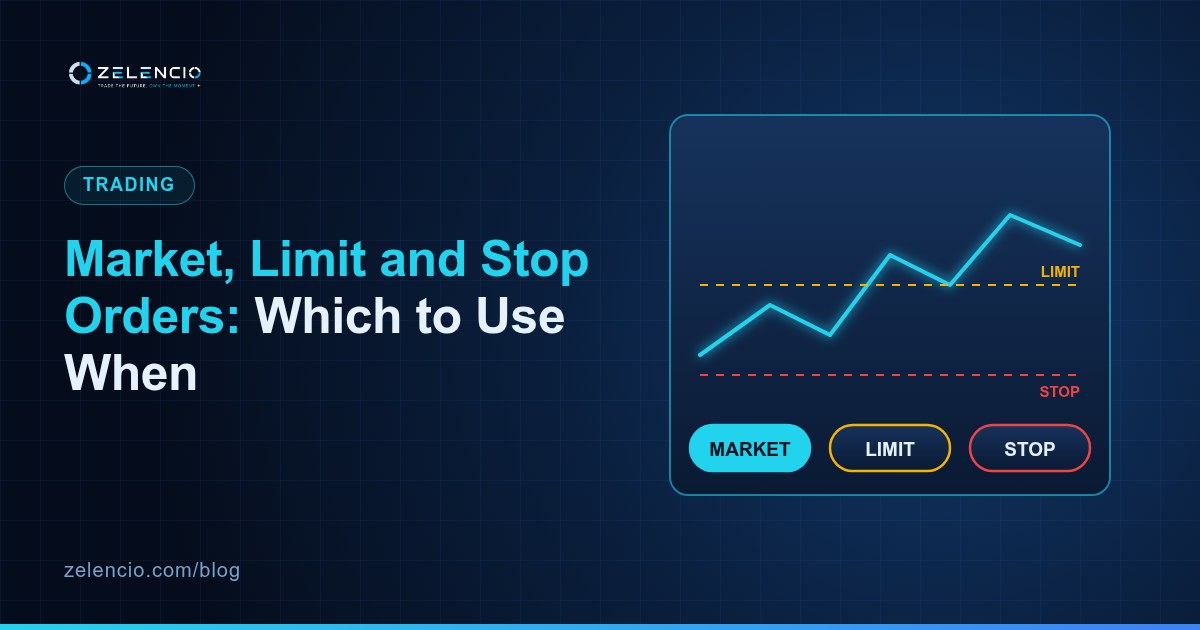
Three order types cover almost everything you will ever need. Understanding them properly will save you more money than any indicator.
Market order — speed over price
Buys or sells immediately at whatever price is available. You are guaranteed to be filled; you are not guaranteed a good price.
On a liquid pair like BTC/USDT that is fine. On a thin altcoin, a large market order can eat through the order book and fill far worse than the price you saw. That gap is called slippage.
Use when: you want in or out now and the pair is liquid.
Limit order — price over speed
You name your price. The order sits waiting and only fills if the market reaches it. You control the price exactly; you have no guarantee it ever fills.
Use when: you have a price in mind and can wait. Also the right choice on any thin market, where a market order would cost you.
Stop-loss — the one that protects you
An order that triggers when the price falls to a level you set, closing the position before the loss grows.
This is the difference between a bad trade and a catastrophic one. The trader who loses everything is almost never the one who was wrong — it is the one who was wrong and refused to accept it, waiting for a recovery that kept not arriving.
Set it when you open the position, while you are calm. Deciding where to exit after the price has already fallen 30% is not a decision, it is hope.
A trade with all three
You want Bitcoin at $60,000. It is trading at $62,000.
- Limit buy at $60,000 — waits for your price.
- Stop-loss at $57,000 — caps the damage if you are wrong.
- Limit sell at $70,000 — takes profit without needing to watch.
Every outcome is now decided in advance, while you are thinking clearly. That is the actual point.
The most common mistake
Moving a stop-loss further away because the price is approaching it. That converts a small planned loss into an unplanned large one. If you would not set it there now, you should not be in the trade.