
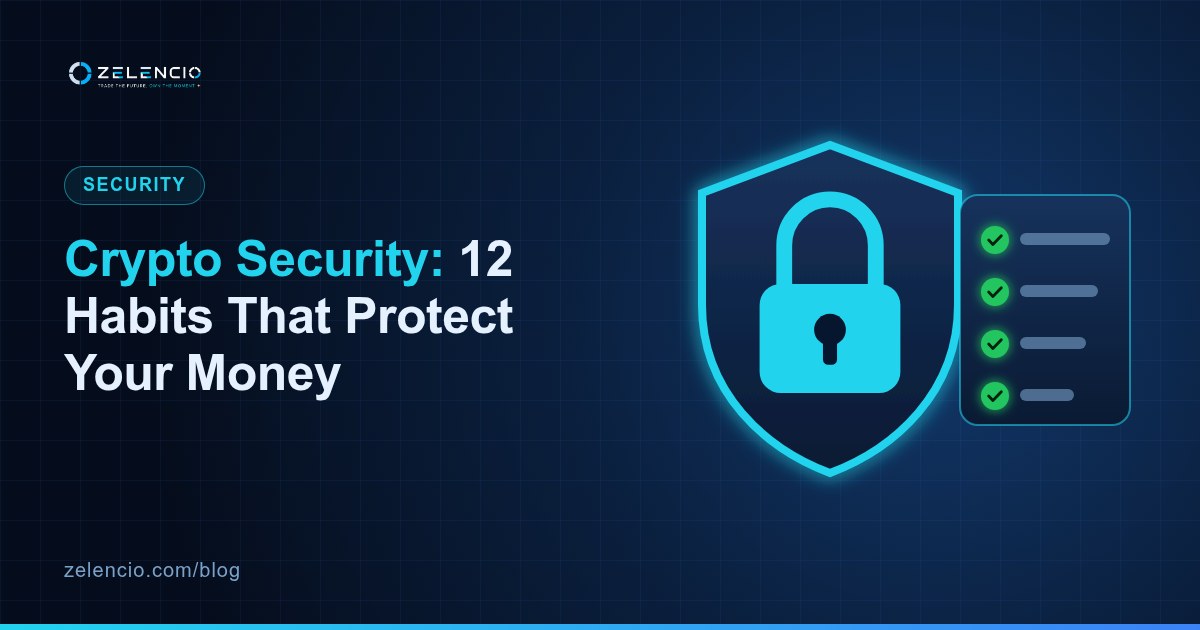
Crypto Security: 12 Habits That Protect Your Money
Published 29 July 2026
Almost nobody loses crypto to sophisticated hacking. They lose it to a reused password, a fake support agent, or a link they should not have clicked. These twelve habits prevent nearly all of it.
1. Use an authenticator app, not SMS
SIM swapping — an attacker convincing your network to move your number to their SIM — is common and effective. An authenticator app on your device cannot be transferred by a phone call to customer service.
2. A unique password, everywhere
Breaches happen constantly. If your exchange password is the same as one from a shopping site breached in 2019, it is already in a list somewhere. Use a password manager.
3. Bookmark the real site
Fake exchange sites buy ads that appear above the real one in search results. Bookmark it once, use the bookmark forever, never search for it.
4. Nobody legitimate asks for your recovery phrase
Not support, not a "wallet validator", not a giveaway. Anyone asking is stealing from you. There are no exceptions to this.
5. Check the address, properly
Clipboard-hijacking malware swaps a copied address for the attacker's. Check the first five and last five characters after pasting, every time.
6. Small test transfer first
Sending a large amount somewhere new? Send a small amount first, confirm it arrives, then send the rest. The fee is trivial insurance.
7. Match the network
ERC20, TRC20 and BEP20 are different roads. Right address, wrong network, and recovery is usually impossible.
8. Turn on withdrawal address whitelisting
Only pre-approved addresses can receive withdrawals, with a delay before new ones activate. Even a fully compromised account cannot be drained instantly.
9. Never discuss holdings publicly
Not on Twitter, not in a Telegram group, not with people you met online. Wealth attracts attention, including the kind that shows up at your door.
10. Treat urgency as a red flag
Every scam runs on time pressure. "Act now", "expires today", "your account will be suspended". Real organisations give you time. Urgency exists to stop you thinking.
11. Separate your email
An email address used only for exchanges, never posted publicly, never used for signups. Your email is the master key to everything else.
12. Review your devices monthly
Check active sessions and logged-in devices. Remove anything you do not recognise, and anything you no longer use.
Ranked by what actually saves people: authenticator app, unique password, never sharing your recovery phrase. Those three prevent the overwhelming majority of real losses.