

How Crypto Fees Actually Work
Published 1 August 2026
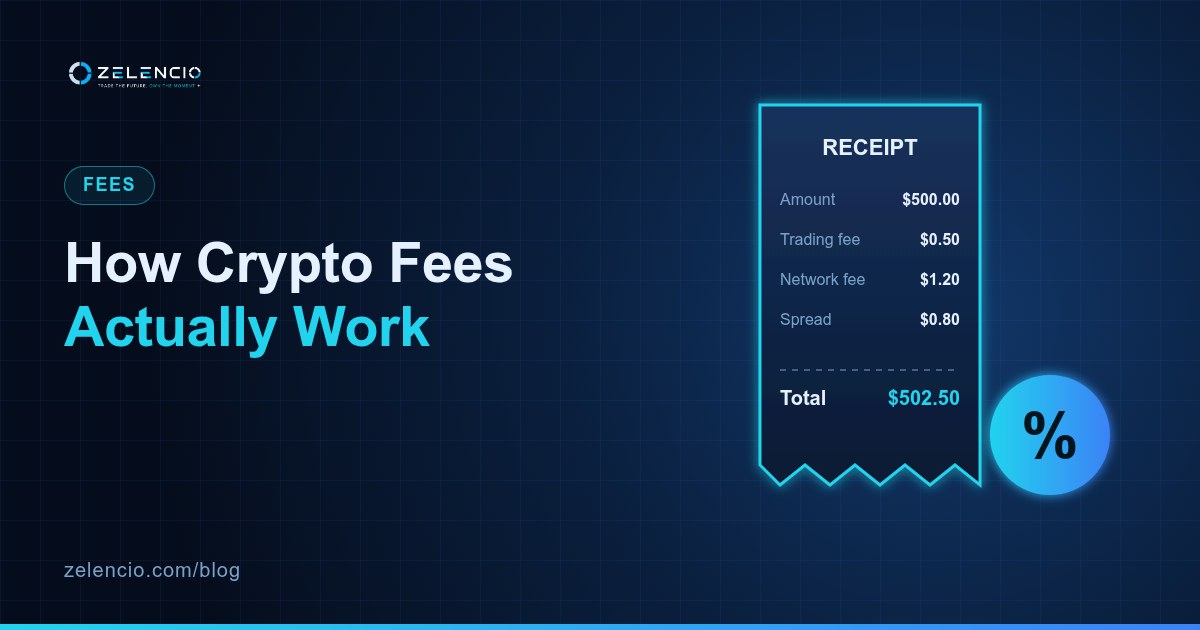
Crypto fees confuse people because there are several different kinds, charged by different parties, at different moments. Here they are separated out.
Network fees
Paid to the blockchain itself for processing your transaction. The exchange does not receive this and cannot waive it.
It varies with congestion, not with amount. Sending $10 or $10,000 costs roughly the same. This is why small transfers on expensive networks make no sense — a $12 fee on a $20 transfer is most of your money.
Rough guide: Bitcoin is moderate and spikes when busy. Ethereum can be very expensive at peak. Tron and BNB Chain are usually cents. Same asset, wildly different cost depending on the network you pick.
Trading fees
A percentage of each trade, usually under 0.2%. Often split into maker and taker:
- Maker — your limit order sits on the book and adds liquidity. Cheaper.
- Taker — your order fills immediately against existing orders. Slightly more.
Trade often and this compounds. Ten trades a day at 0.1% is 1% of your capital daily in fees alone, before any losses.
The spread — the fee nobody mentions
The gap between the best buy price and the best sell price. Buy at $100 and immediately sell, and you get slightly less back. That difference is a real cost even where the fee shows as zero.
"Zero fee" services almost always widen the spread instead. The cost did not vanish, it moved somewhere less visible.
Deposit and withdrawal
Crypto deposits are usually free. Fiat deposits vary — bank transfer is typically cheapest, card most expensive because the card networks charge the platform.
Crypto withdrawals carry the network fee. Fiat withdrawals often carry a flat charge, so batching one larger withdrawal beats several small ones.
Practical ways to pay less
- Pick the right network. Same USDT, cents versus dollars.
- Use limit orders for the maker rate.
- Withdraw less often, in larger amounts.
- Trade less. Genuinely the biggest saving available to most people.
- Send during quieter hours — network fees fall when demand does.