How to Read a Crypto Chart Without Getting Lost
Published 27 July 2026
A trading chart looks like noise until someone shows you the four things that actually matter. Then it stays mostly noise, but useful noise.
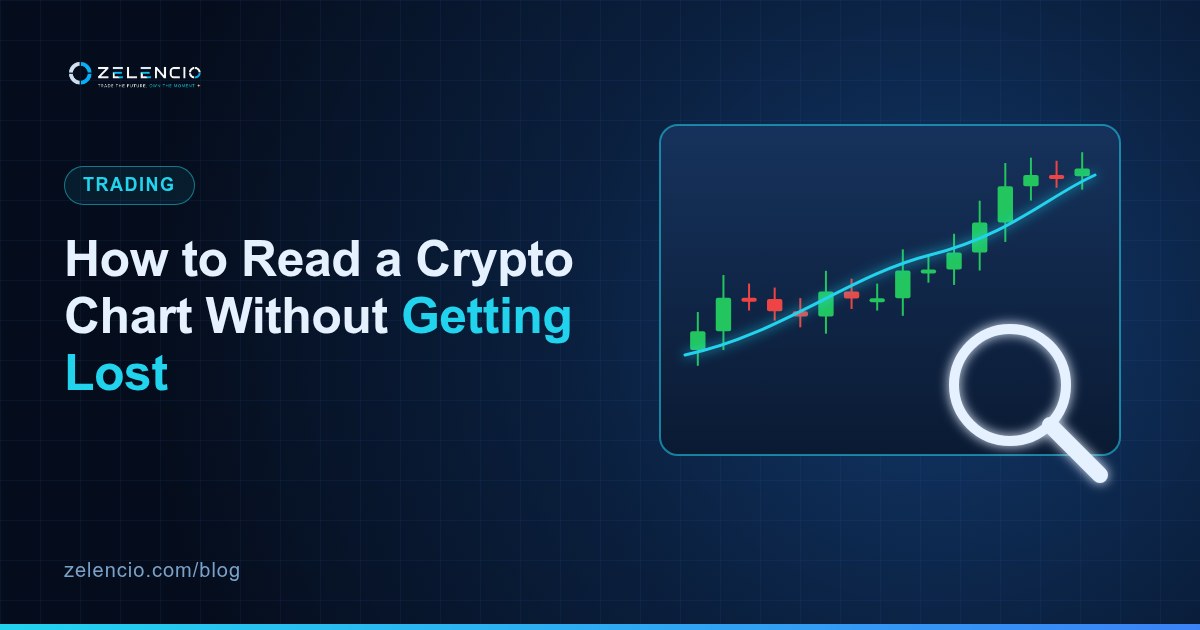
Candles
Each candle covers one period — a minute, an hour, a day, depending on your setting. It shows four numbers:
- Open — the price when the period started
- Close — the price when it ended
- High and low — the extremes in between, shown as thin wicks
Green means it closed higher than it opened. Red, lower. The thick body is open-to-close; the wicks are how far it stretched and came back.
Long wicks are informative. A long lower wick means sellers pushed the price down and buyers pushed it all the way back — a fight that buyers won.
Volume
The bars underneath show how much was actually traded. This is the part beginners skip and it is the most important.
A big price move on low volume means very few people were involved and it can reverse easily. The same move on high volume means real conviction. Price tells you what happened; volume tells you whether to believe it.
Support and resistance
Prices where the market has repeatedly turned around. Support is a floor buyers keep defending. Resistance is a ceiling sellers keep hitting.
These are not physics. They work because enough traders watch the same levels and act on them. When a level finally breaks, it often flips role — old resistance becomes new support.
Timeframes change the story
A crash on the 5-minute chart can be invisible on the weekly. Zoom out before reacting to anything. Most panic comes from staring at too short a timeframe.
What charts cannot do
They cannot predict. Every pattern that "always" works has failed repeatedly. Charts describe what has happened and what other traders are likely watching. That is genuinely useful and it is not the same as knowing the future.
Be especially wary of stacking indicators. Ten indicators do not give ten times the insight — they give you enough conflicting signals to justify whatever you already wanted to do.