
What Is a Blockchain, Really? An Explanation Without Jargon
Published 23 July 2026
Most blockchain explanations use the word "immutable" in the first sentence and lose everyone. Let us build the idea from scratch instead.
Start with a shared notebook
Imagine a group of friends who lend each other money constantly. Rather than everyone tracking it separately and arguing, they keep one notebook. Every transaction gets written down. Everyone can read it.
Now the hard part: how do you stop someone editing an old page in their favour?
Chaining the pages
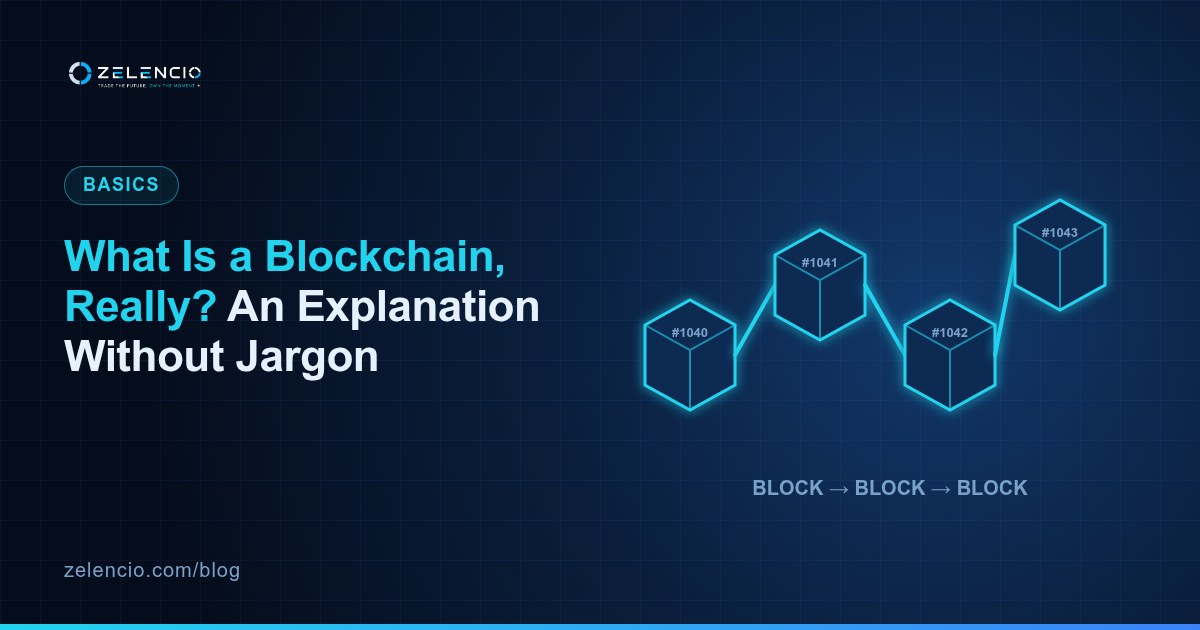
Each page ends with a code calculated from everything written on it. The next page begins by copying that code down.
Change anything on page four, and page four's code changes. Page five now begins with a code that no longer matches. So does page six, and every page after. One edit breaks the whole chain visibly.
That is the blockchain. Blocks of transactions, each cryptographically tied to the one before. You cannot quietly rewrite history, because history is load-bearing.
Why nobody can cheat
Everyone holds their own copy. Rewriting the chain in your copy means outrunning every other copy — recalculating every block since the one you changed, faster than thousands of computers are adding new ones. It is not forbidden. It is simply not achievable.
Who writes the next page?
Two main approaches:
Proof of Work, used by Bitcoin. Computers race to solve a deliberately hard puzzle. The winner writes the next block and is rewarded. It burns real electricity, which is exactly what makes attacking it expensive.
Proof of Stake, used by Ethereum and most newer networks. Participants lock up coins as a deposit and are chosen to write blocks. Cheat, and your deposit is destroyed. Far less energy, same underlying idea: make dishonesty cost more than honesty pays.
What this means for you
Three things follow directly:
- Transactions cannot be reversed. There is no page to un-write. Check the address twice.
- Confirmations matter. Each new block on top makes yours harder to undo. Big transfers, wait for more.
- It is public. Anyone can look up any address and see everything it has ever done. Pseudonymous, not anonymous.